Jiawei Sun
Professor at Suzhou Institute of Biomedical Engineering and Technology (SIBET)
Chinese Academy of Sciences
Career after graduation
After graduating from the Lasers and Photonics programme in 2019, I continued my research in digital holography and computational imaging as a doctoral researcher at TU Dresden. In 2023, I received my Dr.-Ing degree with the highest distinction (summa cum laude) under the supervision of Prof. Juergen W. Czarske. My doctoral research was recognized with several awards in Germany, including the Heinrich Barkhausen Prize, the Dr.-Ing. Siegfried Werth Prize in 2023, and the Gisela and Erwin Sick Foundation University Prize for Measurement Systems Engineering in 2024.
After that, I worked as a postdoctoral research associate at TU Dresden and subsequently as a Young Investigator at the Shanghai Artificial Intelligence Laboratory. In December 2024, I joined the Suzhou Institute of Biomedical Engineering and Technology (SIBET), Chinese Academy of Sciences, as a full professor, with fundings from National Natural Science Foundation of China and Chinese Academy of Sciences. In 2026, I was named a Suzhou Young Scientist.
Current workplace
I am currently a professor at SIBET, Chinese Academy of Sciences, PhD supervisor at University of Science and Technology of China, and Deputy Director of the Jiangsu Provincial Key Laboratory for Advanced Theranostics and Medical Instrumentation.
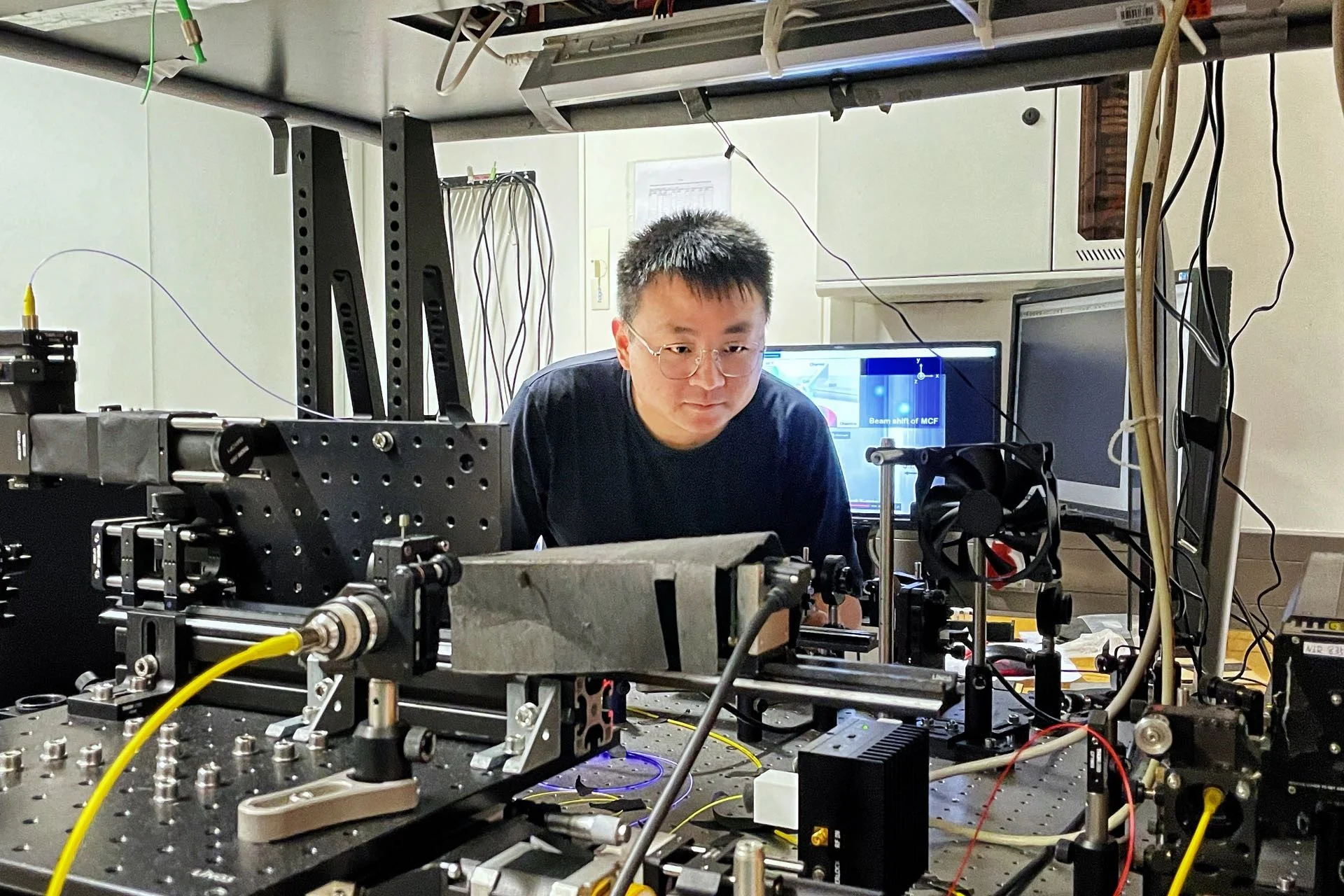
My research focuses on AI-driven computational imaging, especially for microscopy and endomicroscopy. In particular, my group develops new methods and systems for lensless fiber endomicroscopy, fiber-optic imaging, quantitative phase imaging, and optical tomography. Our goal is to translate emerging computational imaging and photonic technologies into compact, intelligent biomedical imaging instruments. I also supervise PhD and Master students and coordinate interdisciplinary collaborations spanning photonics, artificial intelligence, biomedical engineering, and scientific instrumentation.
What do you like most about your job?
What I enjoy most is turning an initial scientific idea into a working imaging system and, ultimately, a useful biomedical tool. Research is rarely a straight path, but understanding unexpected results, solving technical problems, and working with talented students continually bring new ideas and motivation.
To what extent has the Lasers and Photonics programme helped you?
My Bachelor’s degree was in Information Technology, so the Lasers and Photonics programme played a crucial role in helping me transition into the field of optics and photonics. The coursework provided me with a systematic and solid foundation in laser physics, optical engineering, and experimental photonics. This knowledge not only prepared me for my doctoral research, but has continued to benefit me throughout my subsequent work in digital holography, computational imaging, fiber optics, and biomedical photonics.
The programme also offered many opportunities to gain hands on experience through lab courses and research projects. These experiences allowed me to work directly with optical components and experimental systems, helping me develop the practical skills and confidence required to design and conduct independent optical experiments.
Looking back, the combination of theoretical training and practical research experience was extremely important for my entire career development. It enabled me to move from an information technology background into interdisciplinary photonics research and laid the foundation for my long-term development as an independent researcher. I remain deeply grateful to the professors and tutors in Bochum for their teaching, guidance, and support.
(last updated: July 2026)
Country of Origin: China
Current Position: Professor and Deputy Director of Jiangsu Provincial Key Laboratory of Advanced Theranostics and Medical Instrumentation
Current Employer: Suzhou Institute of Biomedical Engineering and Technology, Chinese Academy of Sciences, China
LAP Graduation Year: 2019
Bachelor Degree in: Information Technology
Contact: sunjiawei(at)sibet.ac.cn
LinkedIn profile: https://www.linkedin.com/in/jiawei-sun-3a0291a8