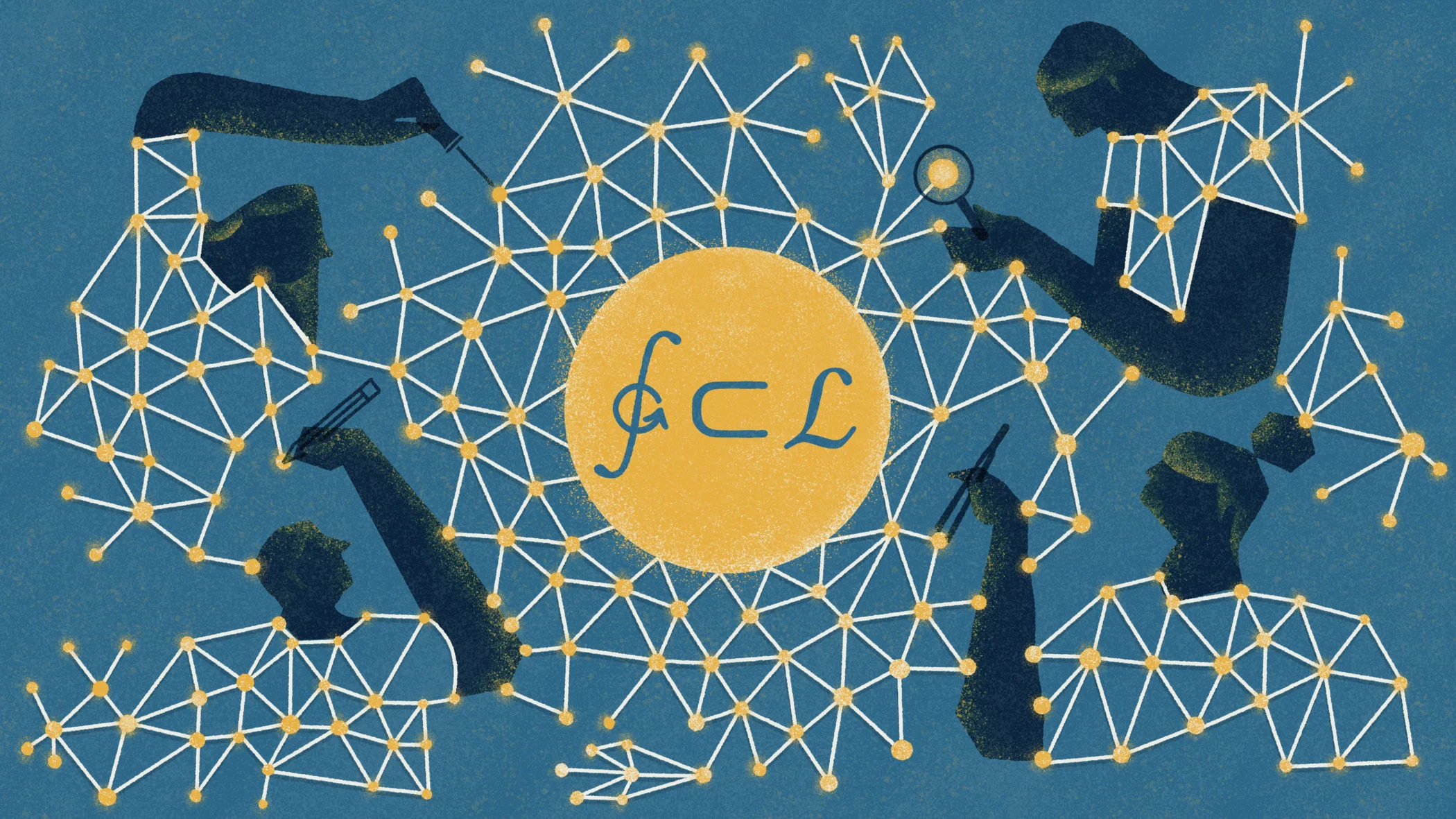
At the heart of SCL lies a continuous process of formation, where research and the individuals behind it exist in a state of being “in the making” fueled by curiosity, collaboration, and shared effort, beautifully captured by the illustrator Michele Sclafani.
Team members are self-defining figures shaped by their deliberate actions and contributions. This reflects a core vision in which members are not merely filling roles but actively constructing their professional identities within a collective endeavour. Each person is equipped with a unique scientific tool, ranging from pens and beams of light to screwdrivers and tweezers. These instruments symbolise our interdisciplinary backgrounds, perspectives, and methods of inquiry, as well as the diverse ways to engage with and shape the group and its research.
What might initially appear as isolated movements, placing a single point, tracing a line, or refining a link, gradually coalesce into a coherent and purposeful whole. Meaning emerges through collaborative work.
We always have a place for high achievers, exceptional talent, and individuals who thrive in pursuing challenging research questions. You can click the titles of individual MPs below to learn more about our planned research. Below are the required candidate profiles for executing the projects, which must include at least one of the following proficiencies and areas of expertise:
Atlas of Change:
- Expertise in theoretical physics, with a focus on non-equilibrium statistical mechanics and field theory. Knowledge of condensed matter physics and the ability to model systems far from equilibrium are essential.
- Expertise in computational and experimental soft condensed matter. Experience with complex fluids, fluid dynamics, multi-scale modelling, and active matter is highly valued.
- Expertise in advanced numerical simulation techniques and sophisticated data analysis.
- Expertise in data-driven and network science, including correlation analysis and graph theory. We require skills in topological data analysis (TDA) to extract meaningful patterns from high-dimensional datasets.
- Expertise in control theory and optimisation. We are looking for individuals capable of designing feedback laws and algorithmic strategies to guide and stabilise complex, fluctuating systems.
- Expertise in multi-scale modelling and simulation. Proficiency in MATLAB, Python, C++, or Julia for high-performance computing, particularly for the numerical integration of stochastic differential equations or agent-based models, is very welcome.
- Expertise in Fourier optics and computer-generated holography (CGH). Experience with spatial light modulators (SLMs), acousto-optic deflectors (AODs), and the design of complex 4f imaging systems is welcome.
- Expertise in ultrafast laser spectroscopy or time-resolved diffraction/microscopy. We are looking for knowledge of pump-probe dynamics and the ability to calculate (and exploit) the relaxation timescales of metastable phases.
- Expertise in chemical synthesis and experimental soft condensed and active matter and materials science.
- Expertise in control theory and machine learning (ML) for physical systems. Real-time FPGA programming, Python/C++ for hardware interfacing, and Bayesian optimisation are very welcome.
- Expertise in nonlinear dynamics and chaos theory. Skills around computational modelling of many-body systems and experience with the Ginzburg-Landau equations or similar field theories will be needed.
- Expertise in quantum fluid dynamics (e.g., polariton condensates, superfluids) with experience working with cryogenic environments and ultra-low temperature optical setups.
Atom Printer:
- Expertise in soft condensed matter and complex physical systems. Experience with active matter, complex fluids, fluid dynamics, and emergent collective behaviour is highly valued.
- Expertise in real-time control systems and high-speed systems engineering. We require strong knowledge of control theory, including optimal control, Lyapunov stability, and feedback design for stochastic systems, as well as experience with FPGA/GPU acceleration and low-latency hardware–software integration.
- Expertise in data-driven methods and machine learning for physical systems. We are looking for experience in deep learning, network science, and topological data analysis to extract structure from high-dimensional, noisy, and transient datasets.
- Expertise in computer vision and state reconstruction. Experience with 3D reconstruction, inverse problems, particle tracking, and deconvolution is highly desirable, particularly for resolving short-lived configurations and rapidly evolving system dynamics.
- Expertise in information theory and adaptive systems. Familiarity with information theory, including entropy production, mutual information, and memory in driven systems, as well as experience in modelling adaptation, learning, and evolutionary dynamics in physical or biological contexts.
- Expertise in materials science, chemical synthesis, or biophysical systems. We welcome candidates with experience in soft/active matter, microfluidics, or living systems, especially those interested in bridging synthetic and biological platforms.
- Expertise in interdisciplinary modelling of lifelike systems.
Rules of Life:
Germany boasts one of the world’s most sophisticated and well-funded research landscapes. This robust ecosystem, spanning federal, state, and private sectors, provides a wealth of opportunities for researchers at every career stage. For a comprehensive overview of the German research environment and national funding bodies, please visit:
Research in Germany: The primary portal for international researchers.
German Research Foundation (DFG): The largest independent research funding organisation in Germany.
Federal Ministry of Education and Research (BMBF): Information on national research strategies and technological advancement.
Germany also maintains a deep culture of philanthropy. Prestigious foundations, such as the Alexander von Humboldt (AvH): offer highly competitive grants and fellowships for innovative studies.
We also recommend visiting the RUB international office website for further information.
Postdoctoral Researchers: Positions within our group are typically funded via competitive third-party grants (e.g., DFG, EU, or industry partnerships) or university programs. We also actively support applicants pursuing independent fellowships:
Humboldt Research Fellowships,
DFG Walter Benjamin Programme, and
Marie Skłodowska-Curie Actions (MSCA).
The RUB Research School provides additional strategic support:
Gateway Fellowships: Bridge financing for transition periods.
Writing Grant: Dedicated funding to support the preparation of DFG or EU proposals.
Grants for Internationalisation.
PhD Candidates: Positions within our group are typically funded via competitive third-party grants (e.g., DFG, EU, or industry partnerships) or university programs. We also encourage DAAD Research Grants: Funding for doctoral studies in Germany.
Master’s (MS) Students: You can apply to the ETIT, LAP, Physics, and Stem Cell Biology (also offered in English) master's program to work with us. For general requirements, please see the RUB enrollment details. We offer paid positions that allow students to contribute to research while earning a competitive wage. In addition, students are encouraged to apply for the Deutschlandstipendium, a merit-based scholarship co-funded by the federal government and private donors. We also recommend visiting: myStipendium to find a stipend.
Undergraduate (UG) Students: We foster early research engagement through summer internships and bachelor's theses. International students are encouraged to apply to Erasmus+ programs. In addition, the DAAD RISE program hosts international interns from North America, the UK, and Ireland for summer research. See the list of previous beneficiaries.A foundation for scientific excellence: We strive to cultivate independent scientific thinkers by positioning advanced research within a highly disciplined mentorship framework. Our core philosophy asserts that creativity flourishes best in well-designed environments where rigour and structure eliminate unnecessary friction. By integrating high-level inquiry with streamlined operational standards, we empower researchers to bypass distractions and dedicate at least 80% of their energy to deep, uninterrupted scientific problem-solving.
Integrated operational and digital support: Our laboratory operates as a sophisticated ecosystem, where administrative, infrastructure, and software development support is provided by our core team. We leverage a comprehensive digital suite to streamline research communication, utilising shared electronic lab notebooks and long-term data archives that encompass every facet of academic life. This systematic approach ensures that all technical and organisational needs are met, allowing the team to maintain a relentless focus on high-impact inquiry and reproducible results.
Proven pathways to leadership: Mentorship is a deliberate, iterative process in our group, specifically engineered to help members achieve career milestones on a reliable schedule. The success of this system is evidenced by our alumni, who have successfully transitioned into roles as independent group leaders, senior industry executives, and startup founders. Beyond internal guidance, our researchers gain access to tailor-made professional development programs, including specialised coaching and strategic advice on grant writing and scientific communication.
Global collaboration and networking: Innovation thrives in a collegial environment where ideas flow freely across disciplines. We actively foster international visibility by encouraging participation in prestigious conferences, workshops, and meetings. These professional connections are further strengthened through established collaborations and research visits at world-leading institutions.
Entrepreneurial and strategic career growth: We bridge the gap between academic discovery and professional application by providing unparalleled access to the regional startup ecosystem and technology transfer centres. Through partnerships with recognised startup alliances, our members gain hands-on experience in commercialising research. Whether a researcher is targeting a future professorship or a leadership role in the private sector, they benefit from a culture grounded in accountability, intellectual curiosity, and a vast network of former members who provide strategic insights into the global job market.
RUB as a champion of interdisciplinary studies and a culture of collaboration: As a true campus university, RUB operates under the “UniverCity” concept, bringing together physics, engineering, life sciences, and computational disciplines in immediate spatial proximity. Unlike institutions with dispersed departments, RUB’s layout allows for interdisciplinary “shortcuts” to form naturally, making collaboration a daily condition rather than an exception. Research centres like Solvation Science, Complex Interactions, and Cyber Security bridge disciplinary boundaries, creating a continuous think-tank environment. The Welcome Centre provides dedicated assistance for international faculty and students, streamlining relocation and academic onboarding. RUB further offers structured training and support provided by the transfer and start-up centre Worldfactory and the Bryck Start-up Alliance, which has been officially recognised by the German Federal Ministry for Economic Affairs and Energy as a national Start-up Factory, gaining hands-on experience in entrepreneurship, technology transfer, and the commercialisation of research.
The Ruhrgebiet as a region of transformation and lifestyle: Bochum reflects the Ruhr’s evolution from an industrial heartland into a knowledge-driven urban environment. It offers a high quality of life, characterised by affordable living costs, short commutes, and proximity to hubs such as Dortmund, Essen, Düsseldorf, and Cologne. A landscape interwoven with green corridors, rivers, and repurposed industrial spaces is perfect for outdoor activities. It also offers short commutes to world-class museums, theatres, and festivals across the Rhine-Ruhr area, as well as easy access to European capitals like Amsterdam, Brussels, and Paris via an exceptional rail network.
North Rhine-Westphalia (NRW) as Germany’s innovation corridor: Known as the “Land of 1,000 Labs,” NRW is Germany’s most populous state and a powerhouse of academic and industrial networking. NRW hosts Germany’s strongest chemical industry cluster, providing a direct bridge between fundamental research and industrial applications in materials science and catalysis. RUB is a key member of the University Alliance Ruhr, a “mega-university” triad with TU Dortmund and the University of Duisburg-Essen, supporting over 120,000 students and deep research integration. A dense ecosystem where legacy industries coexist with a burgeoning startup scene, creating pathways from lab to market.
The German advantage of stability and support: Germany provides a robust institutional framework that anchors the local excellence of RUB and NRW. It continuously provides access to stable public research funding and long-term academic career structures. There is an international talent focus with a pragmatic, integration-oriented approach to welcoming global researchers. Academic freedom is exceptionally valued in a system characterised by openness, diversity, and strong support for fundamental science.
Intellectual independence and proactivity: Our framework automates guidance so you can prioritise critical thinking. We provide the scaffolding for your growth, transitioning from mentorship to partnership as you refine your autonomy. This succeeds when you treat your research as a venture you own entirely, driving concepts through to execution while utilising our rigorous debate culture to test and refine your findings.
Professional integrity and reproducibility: Reliability is the currency of high-impact inquiry. We maintain a systematic infrastructure for data and ethics to ensure that every result is a permanent contribution to the field. By adhering to these exacting standards, you ensure that your work is not just a personal achievement but a reproducible benchmark for global scientific excellence.
Active collaboration and community engagement: Collective intelligence is an operational requirement, not an elective. Our environment functions as a high-output network where your active engagement serves as the primary catalyst for team-wide innovation. We expect you to leverage this ecosystem to contribute to peer development and global discourse, amplifying both the group’s influence and your professional trajectory.
A dedication to constant evolution: Agility is sustained through a disciplined approach to feedback. We view every project milestone as a data point for your personal development, providing the programs and networking channels necessary to pivot your expertise toward emerging global demands. Your role is to remain “career-fit” and consistently refine your technical and leadership craft to bridge the gap between discovery and real-world application.