
RD 2: Universal Self-Assembly
MP 2: Atom Printer
Nature is the world’s most sophisticated factory. Unlike human manufacturing, which relies on carving material away or stacking it up, biological systems don’t "build" in the traditional sense. Instead, they encode a set of rules that allow matter to organise itself. From the precision of DNA replication to the elegance of protein folding, nature uses self-assembly, a process where complex structures emerge spontaneously from local interactions.
The Atom Printer (MP 2) aims to harness this third paradigm, moving beyond step-by-step construction toward massive parallelism. By triggering trillions of simultaneous molecular processes, akin to biological constructions, we envision a future where physical objects are instantiated as seamlessly as printing a digital document.
Building at the atomic scale requires a sophisticated navigation system to manage the chaos of the micro-world. Therefore, Atom Printer (MP 2) integrates with the Atlas of Change (MP 1), using its navigation system to command the dynamic states needed to stabilise programmable matter. By applying the Rules of Life (MP 3), the printer transcends static construction, enabling dynamic, adaptive materials that evolve and respond to their environment in real time.
What began as a fascination with the Star Trek replicator has matured into a rigorous scientific pursuit. In collaboration with NLE and as outlined in a recent book chapter, we identified three fundamental limitations of modern additive and subtractive manufacturing:
1. Fat Fingers Problem (λ ≫ a₀). Fabrication tools are too coarse and limited by factors such as light wavelength to address matter at the atomic scale.
2. Problem of the Explosion of Complexity. Shrinking feature size causes a cubic increase in the number of elements to control, making atom-by-atom fabrication intractable.
3. Problem of Fluctuations. At atomic scales, thermal fluctuations dominate, undermining precision control.
We then examined how driven dissipative self-assembly could offer a viable pathway to overcome these constraints, transforming the once-fictional notion of printing matter from the ground up into a credible technological possibility.
Realising this vision requires the development of universal self-assembly strategies that transcend specific techniques, tools, media, or material systems. Our approach, therefore, centres on fundamental physical principles, such as gradients, dimensionality, external fields, flux and flow, as the primary drivers of structure formation.
Below are the ways we systematically investigated these principles across diverse experimental platforms to uncover generalisable pathways for controlled assembly.
System I: Physical vapour deposition in vacuum
We began our journey by designing and fabricating random networks of silicon quantum dots (Si QDs), guided by percolation theory (Nano Lett., 2016; MRS Commun., 2017). We showed that quantum behaviour and electrical connectivity can coexist if topology is engineered across scales.
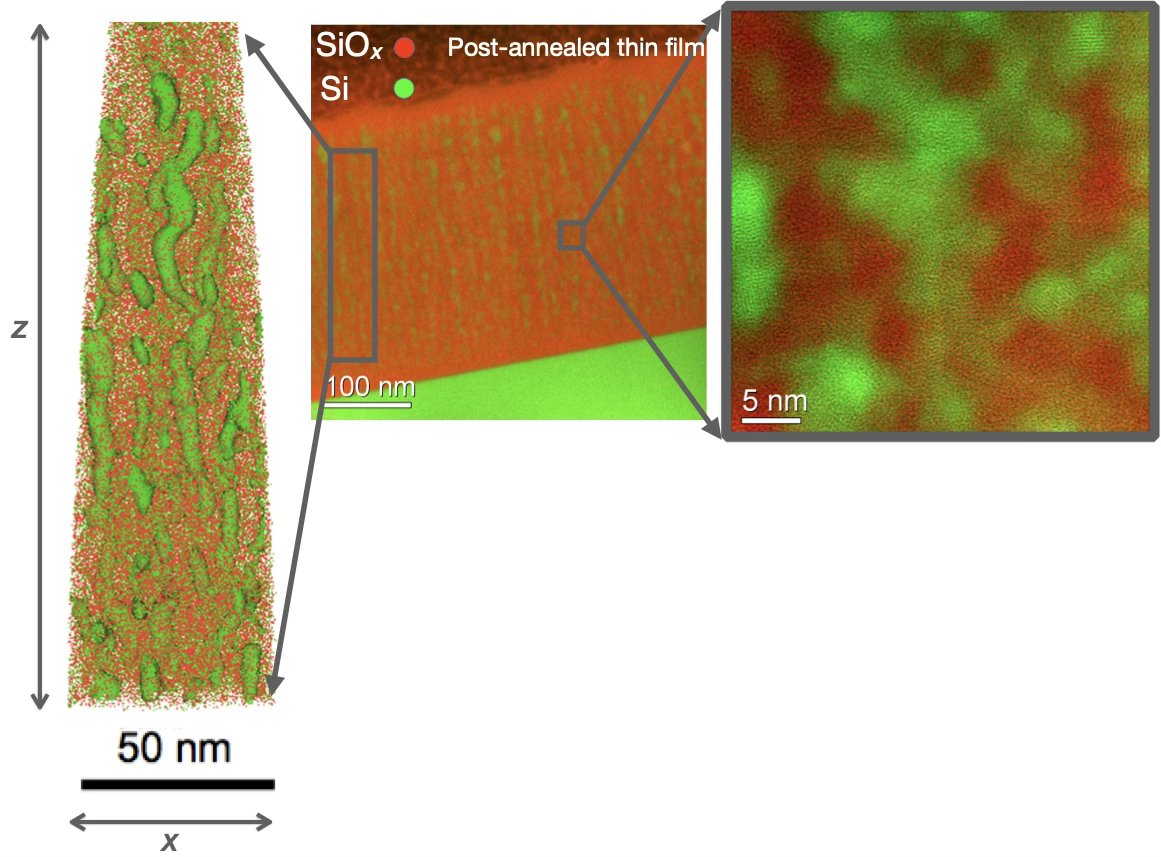
At the nanoscale, Si QDs are randomly embedded in an insulating SiOx matrix to retain a tunable optical bandgap while intermittently linked by narrow crystalline necks that enable direct charge transport (no need for quantum tunnelling). At the microscale, vertically biased growth forms undulated, nanowire-like pathways that efficiently carry charge between electrodes. This hierarchical design creates functional asymmetry: nanoscale randomness supports carrier localisation and quantum effects, while microscale vertical connectivity enables efficient charge conduction, ideal for photovoltaics.
Percolation theory is key. Typically, tuning quantum properties via silicon concentration is limited by a narrow window: above a critical threshold, coalescence (e.g., Ostwald ripening) destroys quantum confinement. We overcome this by reducing effective dimensionality, directing vertical network growth via controlled thermal gradients that limit adatom diffusion. This lowers the percolation threshold for connectivity while raising it for coarsening, opening a regime where transport and confinement coexist. Within this window, we achieved Si QD networks with tunable optical bandgap across a range of sizes.
System II: Ultrafast laser-driven self-assembly in liquid
Building on the foundations of System I, we developed our DDC platform that leverages extremely sharp spatiotemporal thermal gradients to command self-assembly with unprecedented precision. Our goal was to sharpen these gradients and visually capture and quantify the real-time responses of both individual particles and collective dynamics.
We uncovered a large library of dynamic, adaptive patterns ranging from simple Bravais lattices to complex, aperiodic quasicrystals. Our findings reveal the universality of driven dissipative self-assembly (Nat. Phys. 2020). We demonstrated that this process is independent of material geometry, size, or medium, from active nanoparticles (3-nm active CdTe quantum dots in both aqueous and organic solvents) to passive mesoparticles (micron and sub-micron polystyrene spheres) and biological systems (active and passive entities, including Gram-negative and Gram-positive bacteria, yeast, and even human cells within their native growth media).
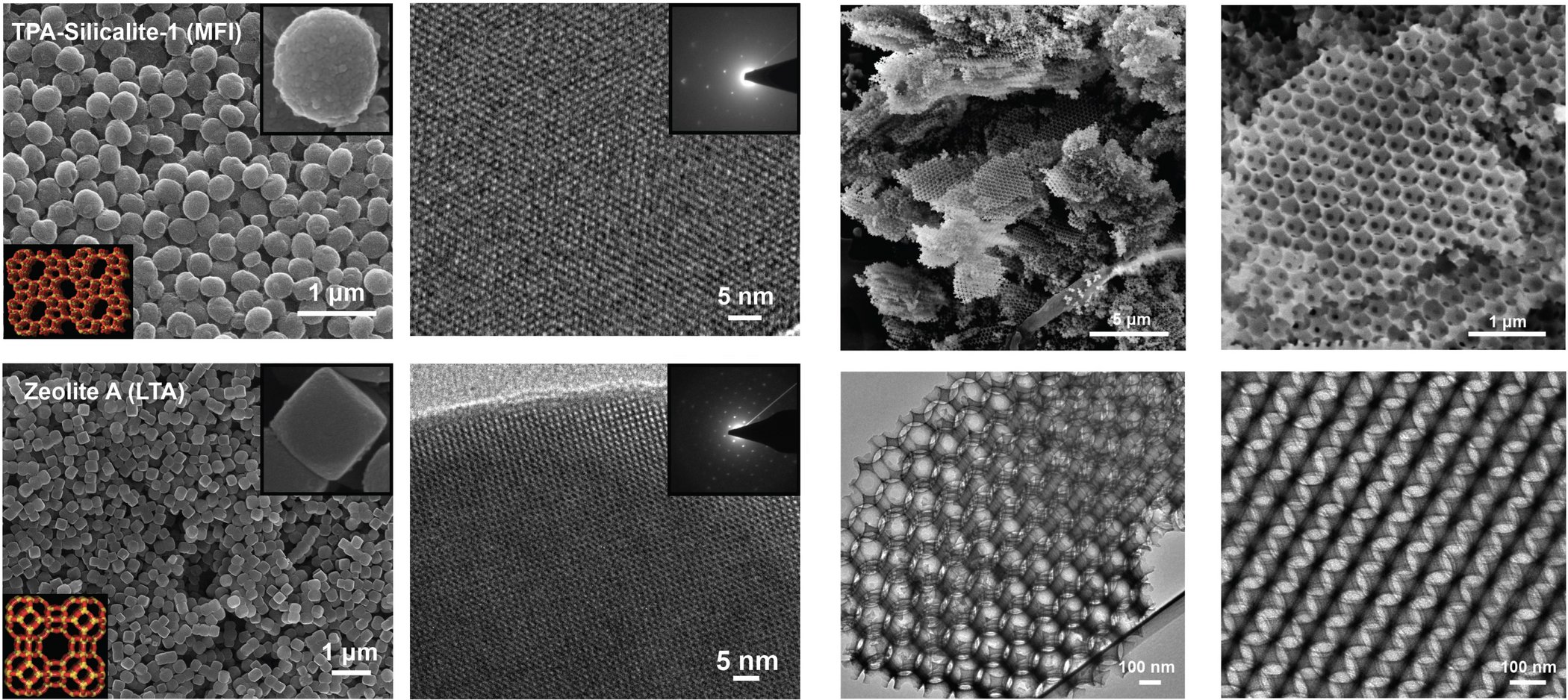
Encouraged by these results, we wanted to control the molecular assembly during chemical synthesis. We chose zeolites, important catalysts with widespread use in everything from gasoline production to water purification and nuclear waste cleanup. We synthesised them with varying pore structures and sizes (Adv. Mater. 2025).
Traditionally, synthesis relied on slow, diffuse thermal energy, essentially “cooking” precursors and waiting for structures to emerge through random molecular collisions. In this study, we utilised the laser beam as a “tiny ultrafast reactor” to replace this passive heating with high-precision, time-resolved energy delivery.
This approach provides critical advantages. Unlike other methods, the synthesis is an actively controlled, non-equilibrium process. The temporal characteristics of the laser pulses match the natural timescales of molecular vibrations and bond formation, potentially enabling the activation of non-equilibrium chemical pathways. By adjusting laser parameters, nucleation and growth can be triggered or paused in real time, effectively “programming” the self-assembly of the framework rather than just setting the initial conditions. This high-precision spatiotemporal control leads to ultrafast crystallisation rates, higher phase purity, and nearly monodispersed crystallinity.
System I: Physical vapour deposition in vacuum
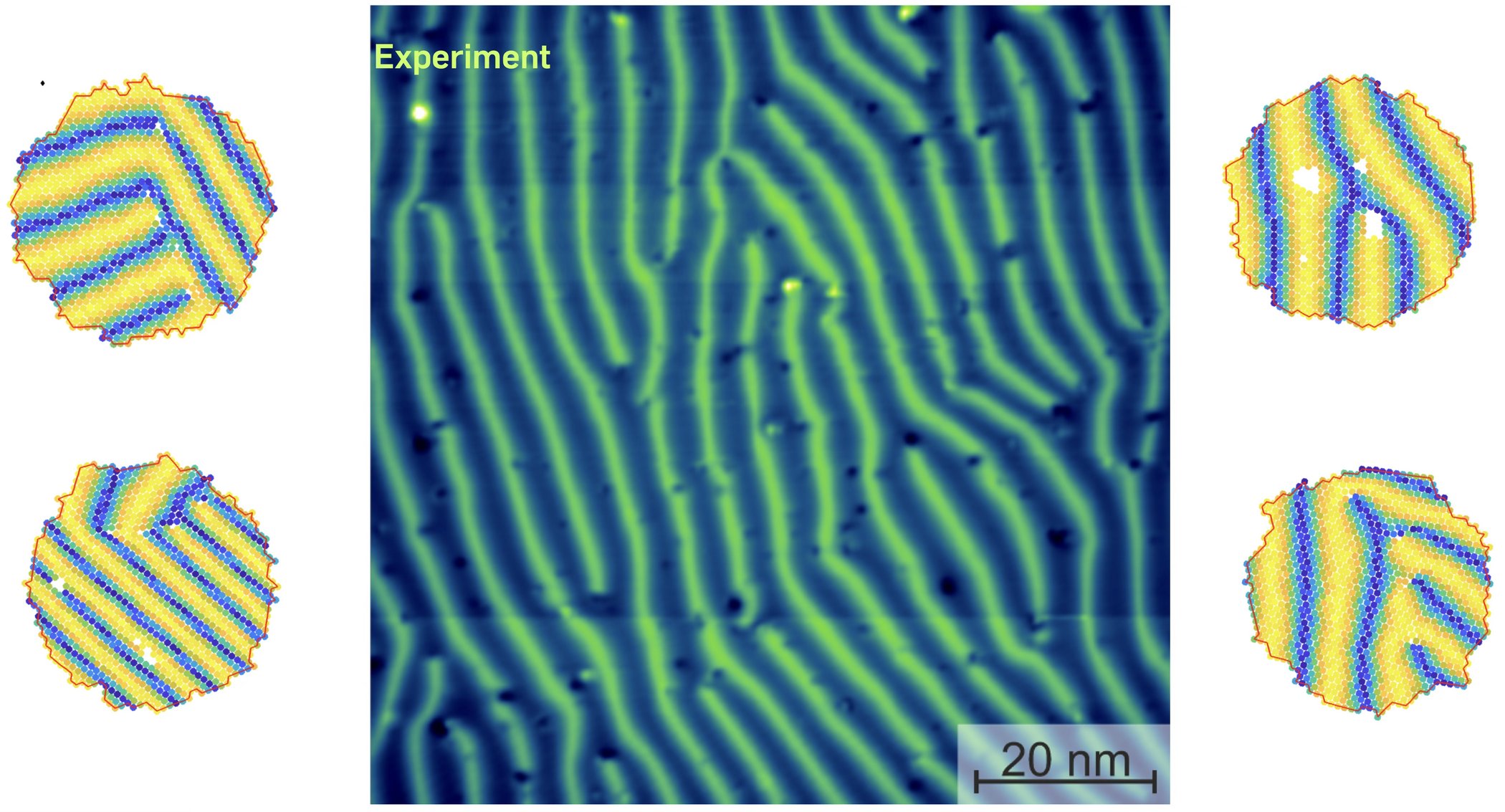
In collaboration with the Chair of Physical Chemistry I, we are investigating complex pattern formation in atomic monolayers. Our collaborators have observed that Xe atoms self-assemble into “zebra-like” patterns on Ag(110) surfaces, driven by Moiré modulations. To explore the dynamics underlying these modulations, we developed a coarse-grained molecular dynamics simulator and uncovered coalescence and competitive dynamics of Xe islands leading to this structure formation during the growth. This research, led by Abdullah Bin Aamir, is currently being prepared for publication.
System II: Ultrafast laser-driven self-assembly in liquid
We are also taking DDC to the next level by utilising gold nanoparticles with photopolymerisable ligands (provided by Prof. Dr. Matthias Karg) to shift from simply observing dynamic adaptive patterns to actively programming and fixing them. If successful, this will allow us to couple high spatiotemporal precision in energy delivery with immediate chemical fixation. This way, we hope to program and preserve complex structures in real time. Haniyeh Ataei and Dr. Simon Spelthann are leading these efforts.