RD 3: AI-Driven Evolution
MP 3: Rules of Life
Biology is not the definition of life; it is merely one instance of it. We view biological life as a local solution to a universal challenge: how matter organises into systems that persist, adapt, and act. Our goal is to strip away the carbon-centric bias to uncover the minimal, fundamental principles that give rise to lifelike behaviour across any substrate.
The Rules of Life (MP 3) moves beyond biomimicry by building AI-driven experimental environments where life is not simulated but allowed to emerge in its native environment and explore alternative metabolisms and non-biological evolutionary pathways. Agency, intelligence, and adaptation arise, not as programmed features, but as emergent properties of intrinsic dynamics. This approach transforms artificial life into a rigorous testbed for a new “Universal Biology,” mapping the vast phase space of what life could be rather than just what it is.
The Rules of Life (MP 3) defines the organisational boundaries and “software” that the Atom Printer (MP 2) uses to transition from building static objects to creating adaptive, lifelike materials. Simultaneously, these rules will be grounded in the emergent agency identified by the Atlas of Change (MP 1). By discovering the code that makes life possible, we aim to move toward a future where we can recognise life beyond Earth and engineer systems that possess the resilience and efficiency of nature itself.
Direction I: Synthetic systems
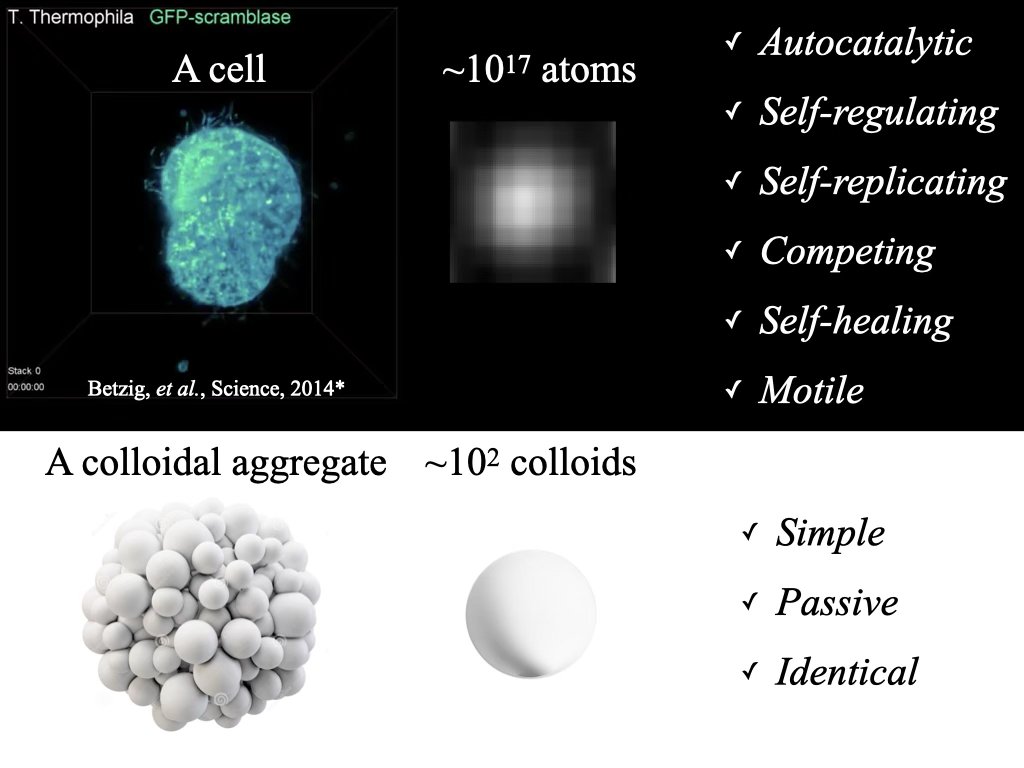
What does it take for “life” to emerge from non-living systems? We explored this question using DDC (Nat. Comm. 2017). By reducing the system to its core physical minimum, we successfully triggered sophisticated, lifelike behaviours in collections of simple polystyrene spheres. These aggregates didn’t just exist; they demonstrated “dynamic resilience”, an ability to instantly adapt, self-regulate, replicate, and repair as their environment shifted. Depending on the physical forces at play, these clusters would either compete for resources or collaborate. All of these occurred without any biological chemistry or pre-programmed instructions, suggesting that the leap from basic physics to complex, adaptive biology is shorter than we once thought.
A second hallmark of life is symmetry breaking, most notably seen in homochirality, the biological dominance of a single molecular handedness. Together with NLE, we investigated how global order emerges from nearly symmetrical initial conditions using NLL (arXiv, 2025) as a framework. Our research identified the minimal conditions and general mechanisms required to selectively amplify infinitesimal asymmetries in growth or concentration. We demonstrated that these fluctuations can lead to the exponential dominance of a single state, producing robust global order without the need for finely tuned or extreme prebiotic environments. This research is currently being prepared for publication.
Direction II: Live organisms
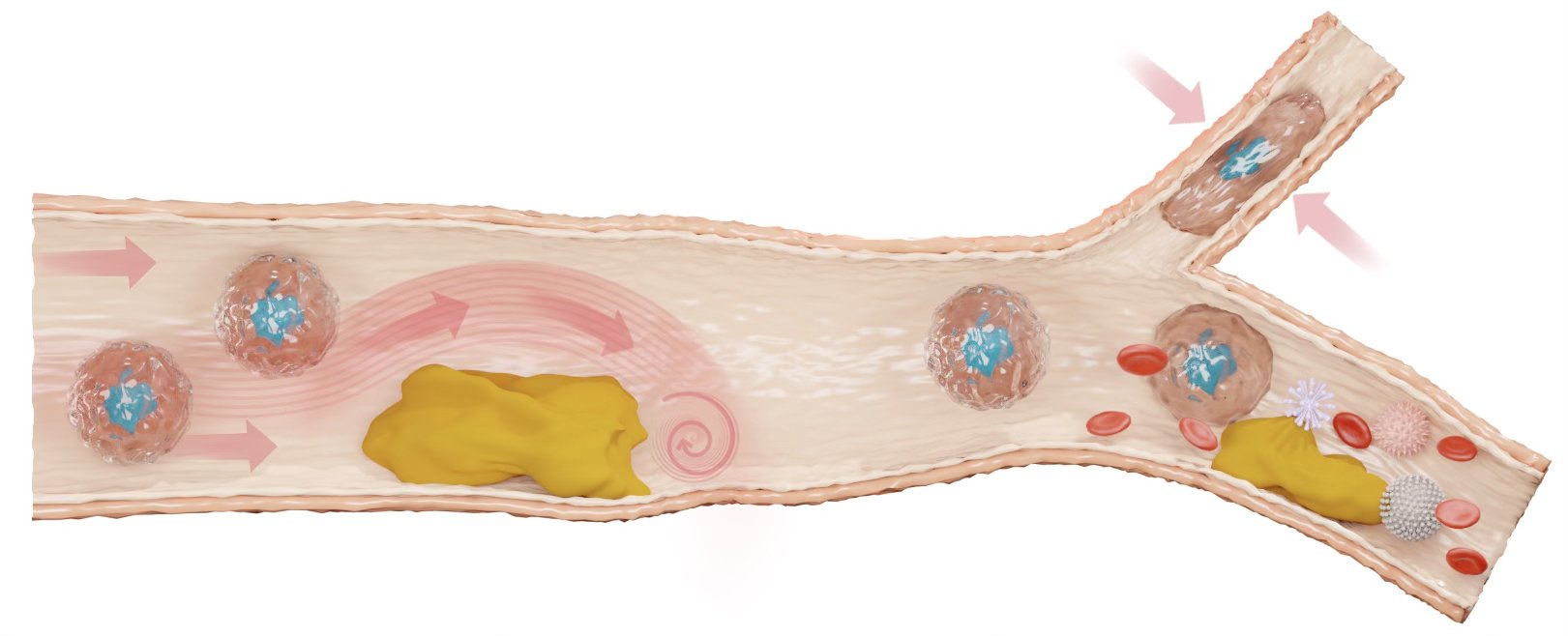
While mutations are the traditional drivers of evolution, recent decades have highlighted the critical role of physical forces in shaping evolutionary processes. This is most evident during an organism’s developmental stage; to survive, new cells must evolve mechanisms to sense and respond to stimuli such as hydrostatic pressure, shear stress, and the geometric constraints imposed by their enclosing membranes. The cytoskeleton serves as a prime example, exhibiting sophisticated self-organisation that alters cell geometry in real time in response to physical stimuli.
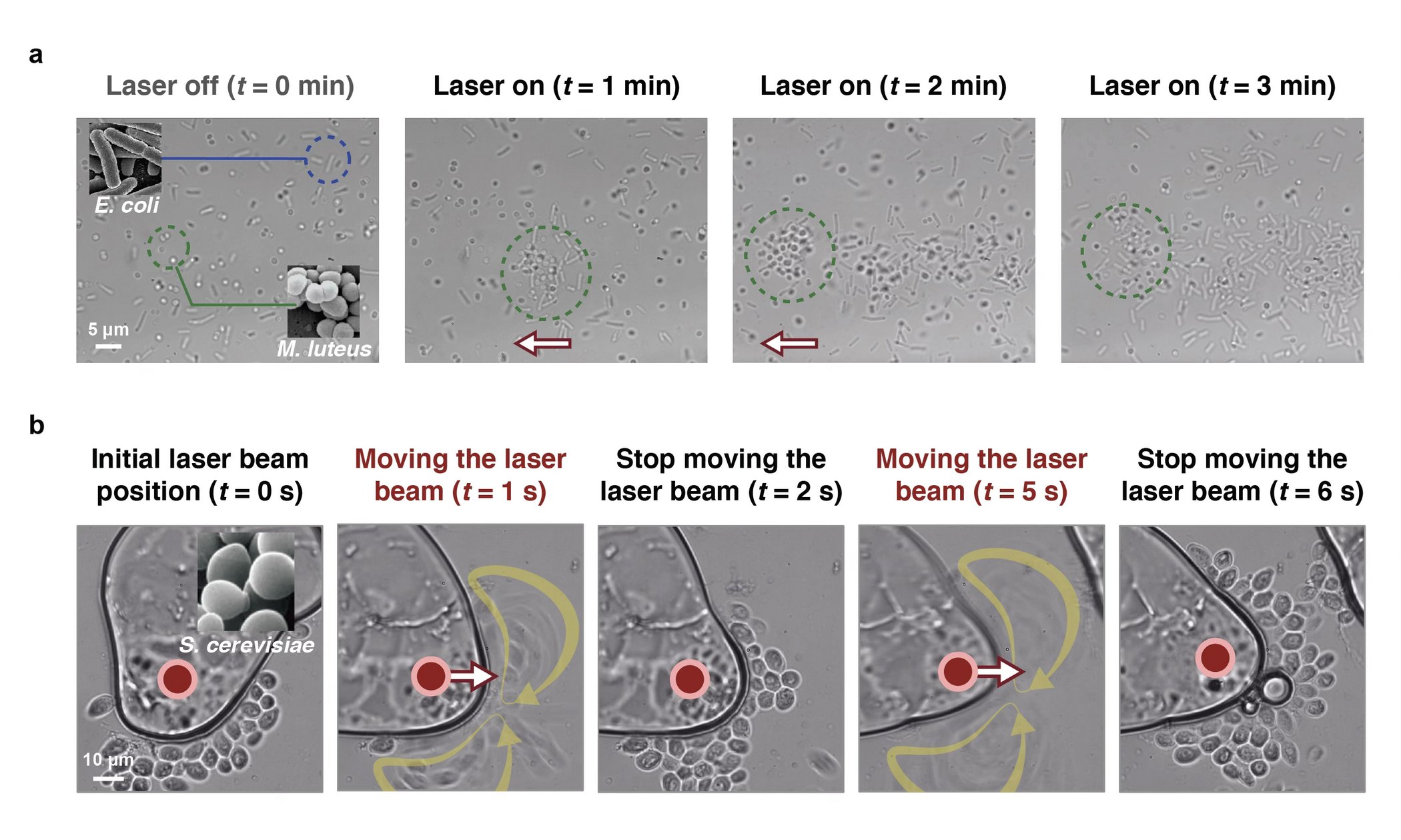
DDC provides unprecedented flexibility, allowing us to apply instantaneous physical stimuli, either through direct contact or by modifying the local environment, with high spatiotemporal precision. Using this technique, we have conducted experiments across a diverse range of suspended cells, including microorganisms, yeast, and mammalian cells.
We investigated active turbulence in P. aeruginosa populations. Demonstrated cell sorting by separating Gram-negative (E. coli) and Gram-positive (M. luteus) bacteria from homogeneous mixtures. We applied geometric constraints and analysed how physical boundaries affect quorum sensing in E. coli. We also studied how circulating tumour cells survive the varying physical stresses of the circulatory system to successfully metastasise.
These studies were initiated in Türkiye, where the majority of the experimental work was completed prior to our relocation to Germany in 2023. Following the move, research involving live organisms was temporarily paused to secure Biosafety Level 1 (BSL-1) certification. With this accreditation successfully obtained in late 2025, we are in the final planning stages to resume laboratory operations. We are currently preparing active turbulence and cancer metastasis work for publication and expect to complete the remaining experimental work in the coming months.
Direction I: Synthetic systems
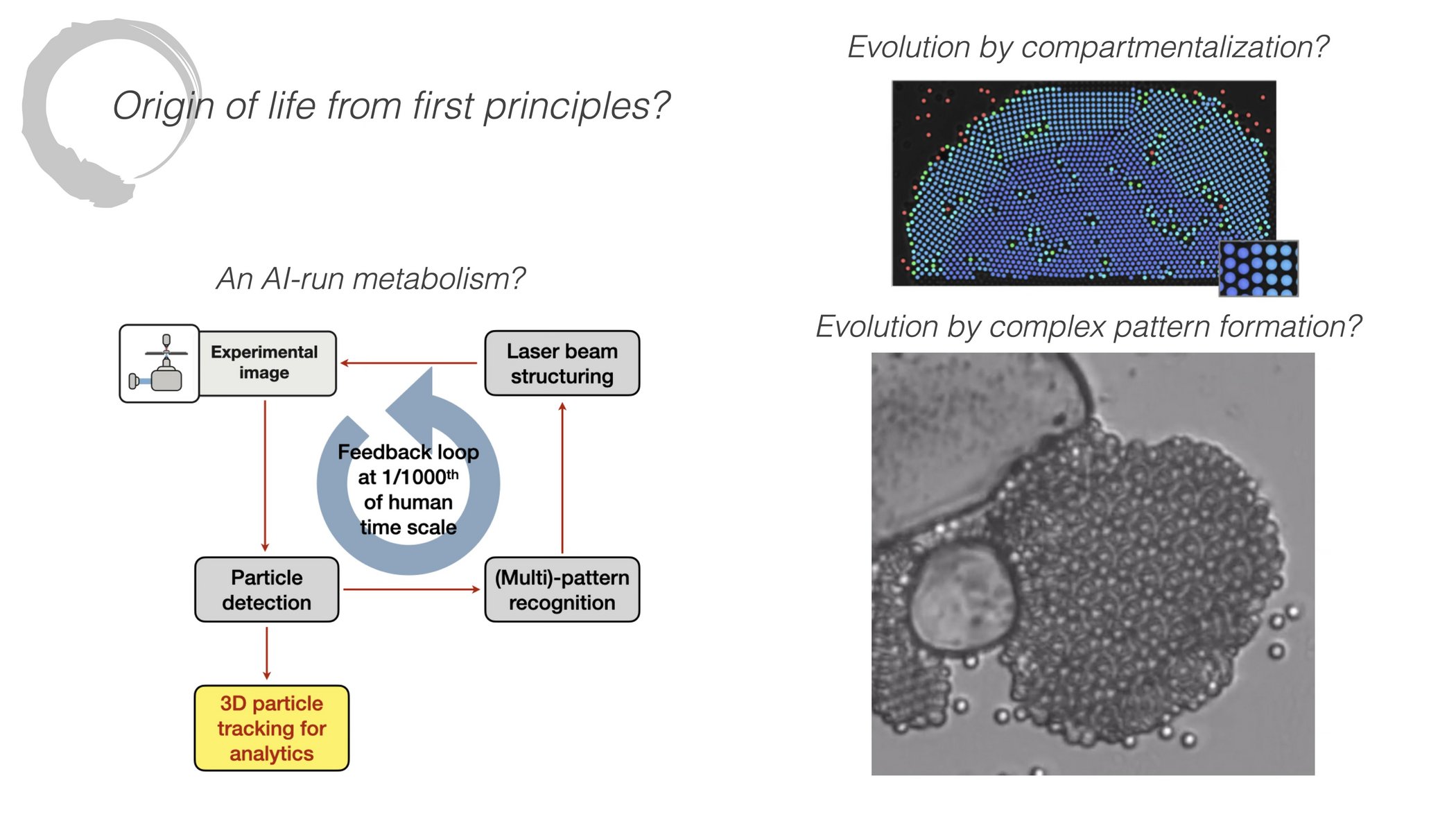
We aim to take a step further by exploring analogues of “metabolism” and “evolutionary pathways” in colloidal aggregates of passive polystyrene spheres. In this context, metabolism refers to the continuous flux of particles, energy, and structure through an aggregate, while evolutionary pathways describe how these structures adapt, reorganise, or transition between states towards more stable solutions under driven conditions.
A central challenge is the stark mismatch in timescales. The intrinsic dynamics of the DDC system unfold on microsecond scales, whereas human observation and decision-making operate on timescales of seconds to minutes. As a result, the human operator can only access a coarse-grained view of the system: identifying where aggregates form, recognising stable pattern types, and noticing major perturbations such as the movement of a cavitation bubble boundary.
However, transient events, such as short-lived structures, rapid boundary fluctuations, local rearrangements, and subtle system-wide responses, remain largely inaccessible. In addition, there is an inherent latency in human intervention: observation, interpretation, decision, and action occur sequentially, introducing delays orders of magnitude slower than the dynamics being studied.
To overcome these limitations, we aim to develop an AI-driven operator that not only reproduces the qualitative observational capabilities of a human but also extends them through continuous, high-resolution quantification. Such a system can capture transient dynamics in real time, resolve fleeting configurations, and systematically track both local interactions and global system responses without the constraints of human perception or reaction time.
As a first step toward this goal, we start by developing methods to detect and track individual particles in full three-dimensional motion. This is non-trivial: although the DDC system is often treated as quasi-two-dimensional, particles frequently move out of plane, causing conventional tracking approaches to lose positional information. By combining tailored experimental design with machine learning algorithms, Dr.-Ing. Özgün Yavuz and Deniz Can Çağlar are working on establishing a framework that successfully reconstructs these 3D trajectories.
Direction II: Live organisms
In addition to setting up our experimental capabilities to resume our previous work, we are currently designing an exciting research study on oligodendrocyte progenitor cells (OPCs) with Dr. Annika Haak. This will be a leap into understanding how the brain’s infrastructure uses physical force to navigate complex 3D environments. This is intended to be the first test of our new 3D tracking framework in a high-stakes biological context. Stay tuned!