
Nonlinearity Engineering
Scientific Direction
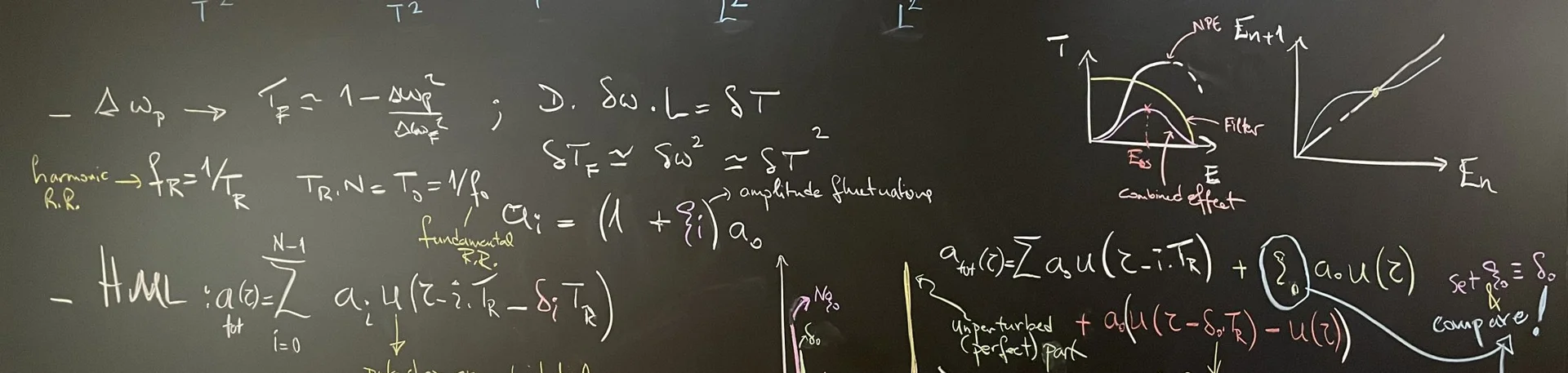
How do nonlinear feedback and fluctuations — amplified rather than suppressed — give rise to emergent structure?
For over two decades, this question has guided our research, shaping a programme that spans laser physics and laser–matter interaction.
Our long-term goal is programmable emergence: the predictive and ultimately prescriptive control of emergent order through engineered nonlinear feedback.
We pursue this agenda using lasers in two roles: as highly controllable model systems of self-organised emergence and as precision tools for interacting with matter.
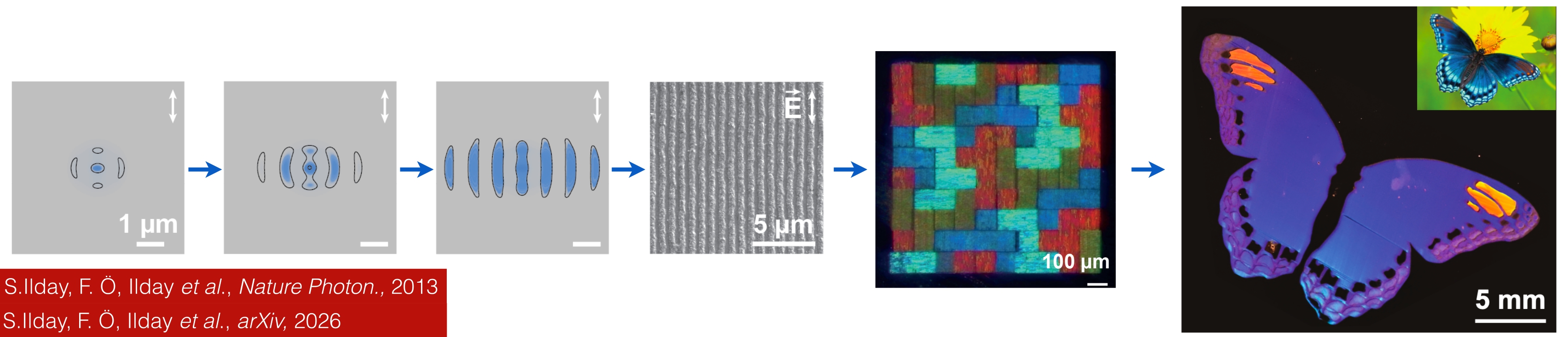
In lasers, this means shaping the dynamics that determine how light organises itself in space and time. In materials, the custom laser systems we develop excite nonlinear responses and generate spatio-temporal gradients with exceptional control. This allows us to steer collective dynamics so that structure forms spontaneously from engineered interaction rules rather than being written point by point. Control over structure is achieved through dynamics rather than geometry and is not fundamentally limited by optical diffraction.
A focal convergence of this programme is the Atom Printer: a framework in which laser-engineered feedback guides atomic self-assembly beyond the geometric limits imposed by optical diffraction.
NLE is also a member of Center for Complex Interactions (CCI).
Experimental Platforms
We design and build ultrafast lasers that the physics demands, rather than adapting research questions to existing technology.
Building on decades of accumulated expertise and purpose-built laboratory infrastructure, we construct laser architectures ranging from new forms of mode-locking to powerful burst-mode systems with repetition rates of ~100 GHz and beyond. We integrate these sources into specialized laser–matter platforms, leveraging our microscopy and holography expertise, and operate across ambient, aqueous, and vacuum environments.
Extreme repetition-rate interactions of ultrashort pulses with matter enable engineered collective effects, memory, and intrinsic feedback that are fundamentally inaccessible in conventional single-pulse approaches.

News
This news article is not available in English
Use the navigation or switch to another language.
Switch to german website