



Scientific Direction
How do nonlinear feedback and fluctuations — amplified rather than suppressed — give rise to emergent structure?
For over two decades, this question has guided our research, shaping a programme that spans laser physics and laser–matter interaction.
Our long-term goal is programmable emergence: the predictive and ultimately prescriptive control of emergent order through engineered nonlinear feedback.
We pursue this agenda using lasers in two roles: as highly controllable model systems of self-organised emergence and as precision tools for interacting with matter.
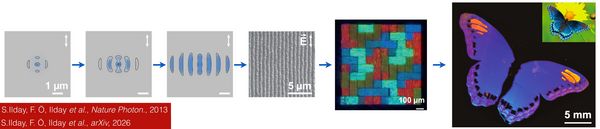
In lasers, this means shaping the dynamics that determine how light organises itself in space and time. In materials, the custom laser systems we develop excite nonlinear responses and generate spatio-temporal gradients with exceptional control. This allows us to steer collective dynamics so that structure forms spontaneously from engineered interaction rules rather than being written point by point. Control over structure is achieved through dynamics rather than geometry and is not fundamentally limited by optical diffraction.
A focal convergence of this programme is the Atom Printer: a framework in which laser-engineered feedback guides atomic self-assembly beyond the geometric limits imposed by optical diffraction.
Experimental Platforms
We design and build ultrafast lasers that the physics demands, rather than adapting research questions to existing technology.
Building on decades of accumulated expertise and purpose-built laboratory infrastructure, we construct laser architectures ranging from new forms of mode-locking to powerful burst-mode systems with repetition rates of ~100 GHz and beyond. We integrate these sources into specialized laser–matter platforms, leveraging our microscopy and holography expertise, and operate across ambient, aqueous, and vacuum environments.
Extreme repetition-rate interactions of ultrashort pulses with matter enable engineered collective effects, memory, and intrinsic feedback that are fundamentally inaccessible in conventional single-pulse approaches.

News
Job opening for postdoctoral researcher (m/f/d) focusing on ultrafast laser physics
NLE is dedicated to exploring the fundamentals, as well as practical imlementation of how to design and experimentally realize nonlinear systems to…
Read more

Workshop "Complex Optics and Modelocking: Synergies on the Horizon" on 22. November.
Modelocking enables the generation of ultrashort pulses of light from laser cavities, a breakthrough that has led to four Nobel Prizes. The process of…
Read more
![[Translate to English:]](/fileadmin/_processed_/b/b/csm_nature_photon_image_0dfd84f986.png "[Translate to English:]")
New publication in Nature Photonics titled "Driven by feedback, unlimited by diffraction".
By exploiting nonlinear feedback arising from the interaction of ultrafast laser pulses, self-organized nanolines that appear to defy the limits of…
Read more
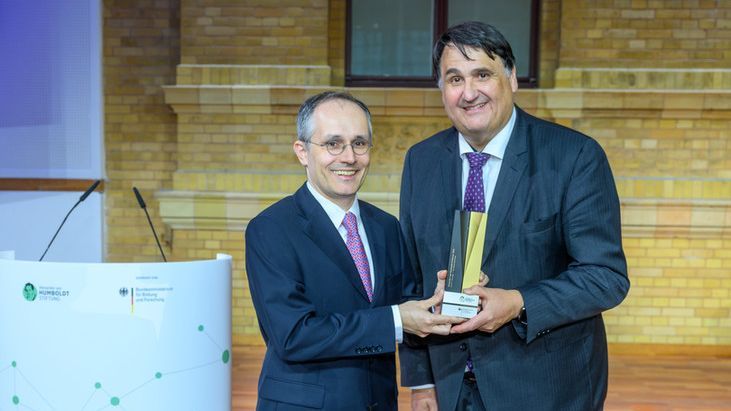
Ömer Ilday erhält Alexander von Humboldt-Professur
Die Bundesministerin für Bildung und Forschung Bettina Stark-Watzinger und der Präsident der Alexander von Humboldt-Stiftung Prof. Dr. Robert Schlögl…
Read more

New co-optations: Prof. Dr. Serim Ilday and Humboldt Professor Prof. Dr. F. Ömer Ilday
On January 31, the Faculty Council of the Faculty of Physics and Astronomy approved the co-optations of Prof. Dr. Serim Ilday and Prof. Dr. F. Ömer…
Read more
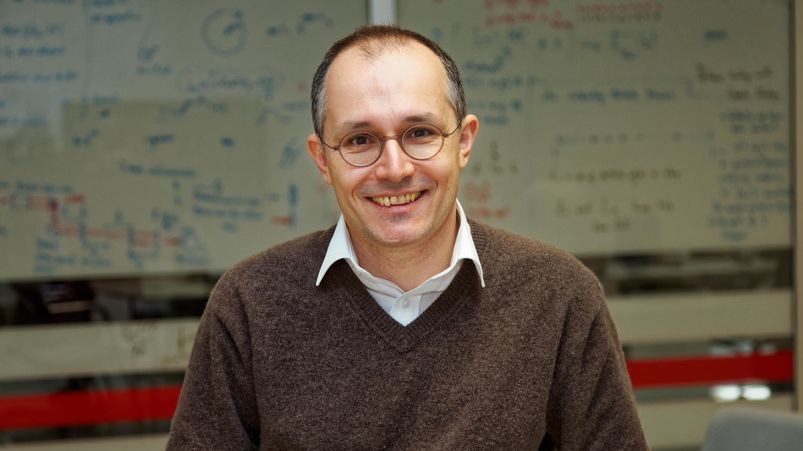
F. Ömer Ilday comes to Ruhr University
The renowned physicist receives the most highly endowed research award in Germany. In Bochum, he is to open up new fields of research in materials…
Read more

Alexander von Humboldt Professorship 2024 Fatih Ömer İlday
F. Ömer İlday has played a seminal role in developing ultrafast laser technology, transforming the field of non-linear laser-matter interactions in…
Read more
Dr. Ilday bringt ERC Advanced Grant, UniLase, an die Ruhr-Universität
F. Ömer İlday promovierte 2003 an der Cornell University, Ithaca, USA, und arbeitete ab 2003 als Postdoc und ab 2005 als Forschungswissenschaftler am…
Read more
